Cryptnox SA
EAN: 7649992538189
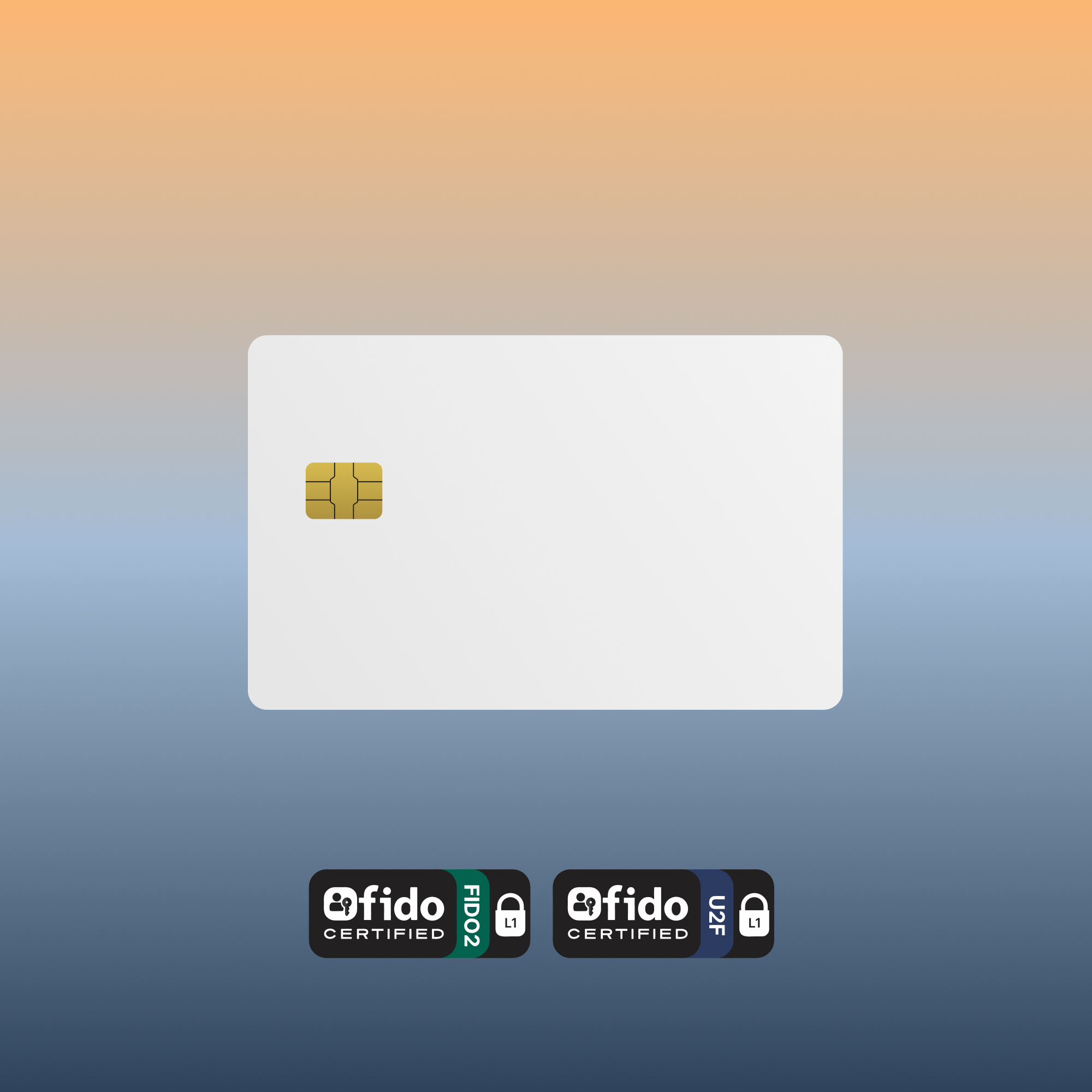
The Cryptnox FIDO2 White PVC card is the customizable variant of our basic FIDO2 security card — a single-application FIDO2 NFC smart card on a blank PVC face ready for in-house printing. FIDO Alliance Certified (FIDO2 v2.1 + CTAP Level 1) for hardware 2FA / MFA on compatible FIDO2 / WebAuthn services, subject to each service’s security-key policy. FIDO2-only SKU — no MIFARE, no DESFire, no physical-access-control applet. For corporate IT, MSPs, and resellers needing branded employee credentials. For per-service and per-platform support — including what works over Android NFC and what does not — see FIDO2 Card Compatibility — Services and Platforms.
CHF 27.54
Tax included. Shipping calculated at checkout.
The Cryptnox FIDO2 White PVC card is the customizable variant of our basic FIDO2 security card — a single-application FIDO2 NFC smart card on a blank PVC face ready for in-house printing. FIDO Alliance Certified (FIDO2 v2.1 and CTAP Level 1), it’s used as a hardware 2FA / MFA second factor on compatible FIDO2 / WebAuthn services (subject to each service’s security-key policy). Passwordless sign-in is supported on the subset of services that have explicitly enabled FIDO2-only login (Microsoft Entra ID, Google Workspace, login.gov, AGOV, etc.).
The blank White PVC face accepts standard ID card printers (dye-sublimation or thermal transfer) — Zebra, Evolis, Fargo, Magicard, Matica. Print employee photo, name, department, company logo, or any combination on each card. Inside, every card carries the same Swiss-engineered FIDO2 chip as our Cryptnox-branded variant. Typical buyers:
The card supports both NFC and contact (ISO 7816) interfaces. On iPhone 7+ running iOS 13.3+, tap supports FIDO2 over NFC; on Android, external NFC keys are supported mainly as CTAP1 / U2F second-factor authenticators, not for full FIDO2 / passwordless sign-in. On a desktop or laptop, use a contactless smart-card reader or a contact reader. For Windows desktop users on the contact interface, the Cryptnox Click-to-Tap Smartcard Reader features a dedicated “tap” button that electronically simulates card extraction and reinsertion (Windows only). See the click-to-tap tutorial for the full workflow.
FIDO2 is the modern open authentication standard (WebAuthn + CTAP2) for phishing-resistant strong authentication. Most services use FIDO2 cards as a hardware second factor — sign in with your password, then tap the card. A growing set of services (Microsoft Entra ID, Google Workspace, login.gov, AGOV) also support FIDO2-based passwordless sign-in. Backed by the FIDO Alliance — a consortium including Google, Microsoft, Apple, Amazon, and major banks — FIDO2 is the foundation of modern hardware-backed authentication on the web.
New to FIDO2 cards? See our FIDO2 Smart Card guide on cryptnox.com for background, certifications context, and platform compatibility.
The blank White PVC surface is dimensioned to standard CR80 ID card printer specs. You can print:
Most local ID badge services or corporate print departments can run a small batch if you don’t have an in-house printer.
Software passkeys are convenient and may sync through cloud ecosystems (iCloud Keychain, Google Password Manager, Microsoft accounts). They are protected by platform security, but some organizations prefer non-synced hardware authenticators for privileged accounts because the private key remains inside a separate secure element and is not replicated through a consumer cloud account. The Cryptnox FIDO2 White PVC card keeps credentials hardware-bound inside the card’s secure element — not cloud-synced, not remotely exportable.
For deployments across an organization, see the FIDO2 White PVC 25-pack. For 500+ or pre-printed batches, get in touch via our contact form.
For setup walkthroughs, integration guides, and service-specific tutorials (Google, Microsoft, Apple, GitHub, Bank of America, login.gov, AGOV, SwissID), browse our FIDO2 tutorials hub.
EAN: 7649992538189
Chip platform certifications (NXP JCOP 4.5 on P71D600):
Applet certification:
Supported elliptic curve (FIDO2 applet):
This is a blank-surface version of our FIDO2 smart card, intended for organizations that want to customize or brand their hardware:
The white face is PVC, compatible with standard ID card printers that handle dye-sublimation or thermal transfer printing. The FIDO2 chip and antenna sit inside fixed zones, so printing in the designated card face area doesn’t affect electrical performance.
The card is standard CR80 credit-card dimensions and works with any PVC ID card printer supporting dye-sublimation or direct-to-card thermal transfer. You can design in any card-printing software (CardFive, CardExchange, Badge Designer, or your printer’s native tool), then print text, logo, or employee photo on the printable area — keep clear of the chip module and antenna zones (visible as a raised square near one corner of the card). A thin laminate overlay is optional but extends card life. Before bulk production, run a test card through your printer pipeline and avoid embossing, hole-punching, aggressive heat lamination, or any printing process not approved for ISO 7816 contact smart cards.
For small volumes, a single-card-input desktop ID printer is sufficient. For larger batches, dual-side auto-feed printers save time. If your organization doesn’t own card-printing equipment, most local ID badge services or promotional-merchandise vendors can run a batch for a per-unit fee.
Yes — IT can register each card to the target user’s accounts before handing it over. Typical onboarding-at-scale workflow:
The employee changes the PIN to their own on first use — either from Windows (Settings → Accounts → Sign-in options → Security Key → Manage) or via the Cryptnox FIDO2 app on a mobile device. The Cryptnox FIDO2 app is for advanced management only (PIN changes, factory reset, resident-key credentials) and is not required for day-to-day sign-in. After PIN setup, only the employee can use the card. Each card stores its FIDO2 keys on-chip, so enrollment is a one-time cryptographic binding and the employee doesn’t need to be present during the initial registration step. Depending on the identity provider, IT may be able to use delegated admin workflows, Temporary Access Pass, or supervised onboarding to assist with registration. Requirements vary by service, and many deployments still require user presence or a user-authenticated session — test the exact IdP workflow before bulk rollout.
OS and browser compatibility: iOS supports FIDO2 over NFC on iPhone 7 and later running iOS 13.3 or newer. Android currently supports only CTAP1 / U2F (FIDO1) for external NFC keys — not FIDO2 / CTAP2. Most major services maintain CTAP1 backward compatibility, so the card works as a U2F second-factor authenticator on Android, but the feature set is reduced and CTAP1 implementations vary. macOS FIDO2-over-NFC support varies by version and browser. Linux browsers expect FIDO2 authenticators on a HID interface — use the Cryptnox FIDO2 HID bridge to present the card to the browser as an HID-FIDO device. Windows 10/11 has full FIDO2 support across all major browsers. Always test with your specific OS + browser + service before rolling out to employees.
Passkeys and FIDO2 hardware security keys use the same underlying cryptographic protocol (WebAuthn), but they differ in where the private key lives:
For consumer use (shopping, social media), passkeys are fine. For accounts that absolutely cannot be compromised — admin accounts, crypto exchanges, banking, government portals (login.gov, AGOV, SwissID), NIS2- and DORA-regulated logins — a hardware key is the industry-recommended approach. Many organizations deploy both: passkeys for low-risk logins, this FIDO2 card for privileged accounts.
Yes — the card is supported by Windows Hello for Business as a passwordless FIDO2 security key since Windows 10 version 1903 (fully in Windows 11), via Microsoft Entra ID (formerly Azure AD).
Standard enterprise deployment:
This delivers passwordless sign-in for Windows desktops, Microsoft 365, and every Entra ID-federated application. For shift-based and shared-workstation environments (call centers, healthcare, retail), passwordless FIDO2 cuts sign-in to a few seconds per shift change.
The card is built on NXP JCOP 4.5 (P71D600) hardware that has been certified under FIPS 140-3 (NIST CMVP certificate #4679). It is not deployed in the configuration covered by that certificate, and Cryptnox does not claim any FIPS certification at this stage. The Cryptnox FIDO2 applet itself is FIDO Alliance Certified (FIDO2 v2.1 + CTAP Level 1).
The underlying NXP platform is Common Criteria EAL6 augmented certified: the N7122 A1 secure controller under BSI-DSZ-CC-1149-V4-2025 and the JCOP 4.5 P71 operating platform under NSCIB-CC-2300127-02 (Netherlands scheme). The Cryptnox FIDO2 applet runs on top of this certified platform and is not itself Common Criteria certified.
The Cryptnox FIDO2 applet performs all cryptographic signing on NIST P-256 (P-256 r1), the curve mandated by the FIDO2 / WebAuthn specification. The underlying chip platform supports additional curves (Brainpool 224/256/320/384/512, NIST P-224 / P-384 / P-521, and Secp256k1) on its ECC coprocessor, but the FIDO2 applet exposes only NIST P-256 to remain spec-compliant.