Cryptnox SA
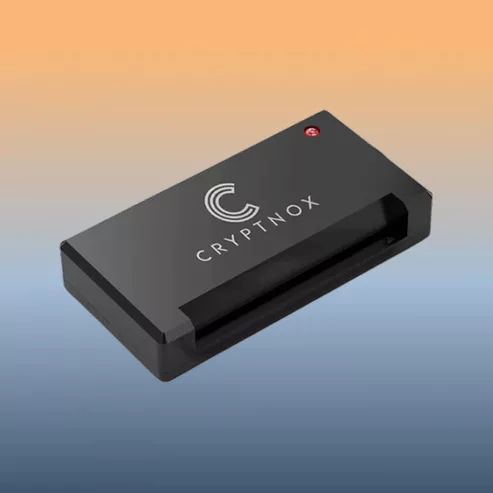
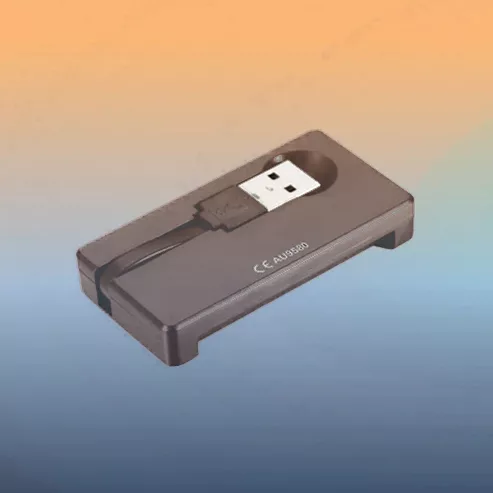
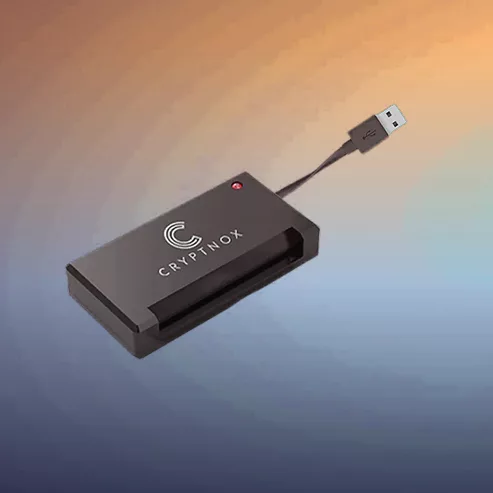
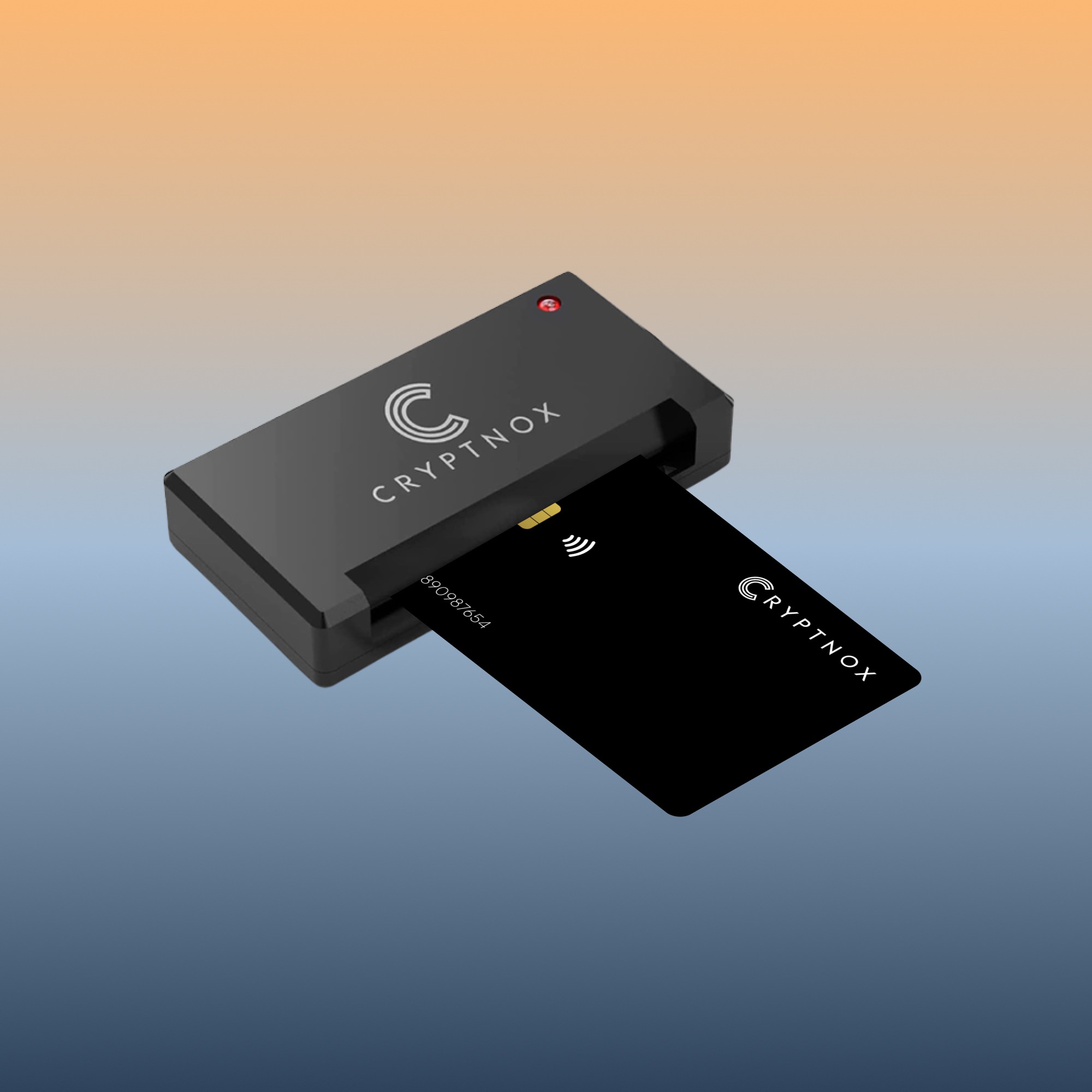
The Cryptnox Mini Smart Card Reader is a compact, USB-A-native ISO 7816 contact smart card reader (no adapter or dongle to carry) for FIDO2 security cards, U.S. DoD CAC, U.S. PIV, government eID (Personalausweis, DNIe, CIE, Belgian eID, Estonian eID), and any ISO 7816 contact card. Plug-and-play on Windows and macOS via native PC/SC stacks; modern Linux distributions need pcsc-lite/libccid/OpenSC installed once; ChromeOS works via the Smart Card Connector extension. For Cryptnox FIDO2 card sign-in on Linux, install the open-source Cryptnox FIDO2 HID bridge: https://github.com/cryptnox/cryptnox-fido2-bridge.
CHF 17.74
Tax included. Shipping calculated at checkout.
This reader is a pass-through USB CCID device. It does not contain a secure element, does not store private keys, and does not sign transactions — all cryptographic operations are performed by the inserted smart card and host software.
The Cryptnox CAC reader is a compact USB-A smart card reader purpose-built for the U.S. Department of Defense Common Access Card (CAC), federal PIV cards, and FIDO2 contact-interface security cards. Pocket-sized and plug-and-play on Windows and macOS via built-in PC/SC stacks; on Linux, install pcsc-lite/libccid/OpenSC; for Cryptnox FIDO2 sign-in on Linux, also install the open-source Cryptnox FIDO2 HID bridge. This CAC reader follows the core reader-side standards used by CAC workflows: ISO 7816, USB CCID, and PC/SC — no Cryptnox-specific drivers required.
In practical terms, yes. A Common Access Card is a standard ISO 7816 contact smart card with PKI certificates loaded onto it. Any USB CCID-compliant smart card reader can read a Common Access Card — whether it’s marketed as a “CAC reader,” a “PIV reader,” or simply a “USB smart card reader.” The Cryptnox CAC reader is a standards-based reader suitable for CAC, PIV, and FIDO2 smart-card workflows on the most common DoD and federal-civilian software stacks. That said, not every USB smart card reader on the market handles every operating system smoothly — Cryptnox readers use the standards-compliant USB CCID class interface, with a documented driver-free install path on Windows, macOS, and Linux.
For NFC contactless workflows (FIDO2 over NFC, MIFARE access badges), see the Cryptnox NFC Contactless Reader. For USB-C native with full-size + SIM dual-slot support, see the Cryptnox Smartcard Reader. To pair this Common Access Card reader with a Cryptnox FIDO2 security card for combined CAC + FIDO2 authentication, browse our FIDO2 lineup.
For setup walkthroughs and reader configuration guides, browse our card reader tutorials hub.
Whether you’re a service member, DoD civilian employee, federal contractor, or anyone needing a reliable Common Access Card reader for daily desktop login, this compact reader supports ISO 7816 contact smart cards, subject to the required host software and middleware:
The Cryptnox CAC reader is a standard USB CCID class device — every modern operating system recognizes it via its built-in smart card stack:
pcscd + libccid + opensc packages (one-time install). Cryptnox FIDO2 sign-in on Linux also requires the open-source Cryptnox FIDO2 HID bridge.USB-A native contact smart card reader. No vendor driver required — Windows/macOS plug-and-play; Linux uses pcsc-lite/libccid (and the open-source Cryptnox FIDO2 HID bridge for Cryptnox FIDO2 sign-in); ChromeOS uses Smart Card Connector. ISO 7816 contact reader for CAC / PIV / eID / FIDO2 workflows. No adapter or dongle required. 2-year warranty.
| USB connector | USB-A (native — plugs directly into any USB-A port, no adapter or dongle required) |
|---|---|
| USB version & speed | USB 2.0 Full Speed (12 Mbps), USB-IF certified |
| USB device class | USB CCID (Chip Card Interface Device) — no Cryptnox-specific driver required — Windows/macOS use built-in stacks, ChromeOS uses Smart Card Connector, Linux uses pcsc-lite/libccid (typically a one-line install) |
| Operating-system support | Windows 10 / 11, macOS, Linux, ChromeOS — uses each OS’s native PC/SC stack (Linux distributions typically require pcsc-lite/libccid) |
| Microsoft WHQL | Yes — controller is WHQL-certified for Smart Card Reader requirements |
| Card standard | ISO/IEC 7816 contact smart cards |
|---|---|
| Card classes | Class A (5 V), Class B (3 V), Class C (1.8 V) — all three voltages |
| Transmission protocols | T=0 and T=1 |
| APDU support | Short APDU and Extended APDU — supports large card-side operations including FIDO2 attestation, RSA-2048 signing, and secure-channel payloads (cryptographic operations are performed by the inserted card; the reader is a pass-through transport) |
| Card slot | 1 × full-size ISO 7816 contact slot (CR80 / credit-card form factor) |
| EMV compliance | EMV-compliant chip-card reader (chip-level) |
| FIDO2 / WebAuthn | Yes — works as a contact FIDO2 reader for Cryptnox FIDO2 smart cards (on Linux, FIDO2 sign-in also requires the open-source Cryptnox FIDO2 HID bridge) |
|---|---|
| U.S. DoD CAC | Yes — works with the standard CAC infrastructure (DoD PKI, ActivClient, MilitaryCAC) |
| U.S. PIV / CIV | Yes — works with PIV middleware (ActivClient, opensc-pkcs11) |
| European eID | Yes — Personalausweis, DNIe, CIE, Belgian eID, Estonian eID (with country-specific software) |
| PC/SC stack | PC/SC 2.0 (Windows WinSCard, macOS CryptoTokenKit, Linux pcsc-lite) |
| API support | PC/SC, CT-API, WINSCARD, PKCS#11-compatible middleware |
| Card power output | 5 V DC, 500 mA max with hardware over-current cut-off |
|---|---|
| Reader power draw | ≈33 mA idle / ≈41 mA reading / 380 µA suspended |
| USB power management | USB selective suspend, USB LPM (Link Power Management), remote wake on card insert / remove |
| Operating temperature | standard indoor office environment |
| Form factor | Compact USB-stick form factor — pocket-sized, ideal for travel |
|---|---|
| Country of origin | Made in China |
| In the box | Mini smart card reader (USB-A native — no adapter required) |
| Warranty | 2 years |
| CE — EMC | Certificate of Compliance (certificate reference available on request). EMC Directive 2014/30/EU; standards EN 55032, EN 55035, EN 61000-3-2, EN 61000-3-3. Test reports available on request. |
|---|---|
| FCC | Supplier’s Declaration of Conformity (SDoC) under FCC Part 15 Class B. SDoC is the FCC self-certification framework for unintentional radiators — it is not a granted FCC ID. Granted FCC IDs are reserved for intentional radiators (transmitters); a passive contact card reader does not require one. |
| RoHS | Certificate of Compliance (certificate reference available on request). RoHS 2 Directive 2011/65/EU as amended by EU 2015/863 + EU 2017/2102 (full 10-substance restriction list). |
Yes — it’s designed for U.S. Department of Defense Common Access Card (CAC) use, plus Personal Identity Verification (PIV) and Common Identity Verification (CIV) cards. It follows the same standards CAC infrastructure is built on: USB CCID, PC/SC 2.0, and ISO 7816. That means it works with DoD PKI, military email (Outlook/OWA with CAC), and any DoD website that requires CAC-based login, using the built-in smart card stack on Windows, Mac, and Linux — no Cryptnox-specific driver needed.
pcscd + CCID + OpenSC). These packages aren’t preinstalled on most distributions — install them first:sudo apt install pcscd libccid opensc pcsc-toolssudo dnf install pcsc-lite pcsc-lite-ccid opensc pcsc-toolssudo pacman -S pcsclite ccid opensc pcsc-toolsMost “CAC reader not working” issues are software, not hardware: (1) ensure you have DoD CA certificates installed (run MilitaryCAC’s installer on Windows, or download from PKI repository); (2) on Mac, install the smart card services for Military CAC from MilitaryCAC.com; (3) restart the smart card service (services.msc on Windows, sudo systemctl restart pcscd on Linux); (4) try the card in the contact slot facing up, gold chip first; (5) test with another CAC to isolate the card vs reader. If the reader itself is not detected as a USB device, try a different USB-A port, another computer, or a powered USB-A hub.
Yes — all are ISO 7816 contact smart cards and communicate with the reader via the same standardized protocol. The reader is just the hardware bridge; each card type also requires its own middleware or application on your computer to authenticate against the target system:
opensc-pkcs11 on Linux).The reader itself is standards-compliant and stays out of the way — no Cryptnox-specific driver or middleware is required.
Any CAC-enabled service that uses the standard Windows / Mac / Linux smart card stack will work with this reader — the hardware side stays out of the way. Common use cases include:
On the software side you’ll need the DoD root CA bundle installed and, for full feature support on Windows/Mac, the ActivClient or MilitaryCAC installer. The reader itself needs no additional Cryptnox-specific software.